When most homeowners think about what their driveway costs, they think about two moments: the day it was paved and the day it has to be replaced. Everything in between feels like free time.
It isn't. A driveway in Las Vegas is aging every day, and the decisions you make (or skip) in those in-between years determine whether you get the full 15 to 20 year life out of your asphalt or pay for a new driveway years early. The costs that hurt aren't the maintenance costs. They're the hidden costs of not maintaining.
Here's what usually gets left out of the homeowner's budget, and how to plan for it.
Hidden Cost 1: The Shortened Lifespan
This is the biggest one, and nobody sees it coming. Properly installed and maintained asphalt lasts 15 to 20 years. Neglected asphalt in the desert can fail far sooner, because the sun dries out the binder, the surface cracks, and monsoon water undermines the base.
Think about what that means in plain terms. If a driveway that should have lasted close to two decades fails years early, you've paid for a full replacement that you didn't need to buy yet. That premature replacement is the most expensive line item in any homeowner's pavement budget, and it's almost entirely avoidable.
The fix is a simple, predictable expense: sealcoating every 2 to 3 years.
Hidden Cost 2: Cracks Get More Expensive Every Month
A hairline crack costs very little to seal. The same crack, left open through a monsoon season and a winter of temperature swings, gets wider, its edges crumble, and water starts softening the base under it. Now it's not a crack sealing job. It's a patching job.
Leave it another year and that patch area might be alligator cracking or a pothole. Each stage costs more than the one before it. The crack didn't change the budget. The waiting did.
If you see cracks now, read how to stop driveway damage before it spreads.
Hidden Cost 3: Repeat Patches That Don't Hold
Bagged cold patch from the hardware store feels like a cheap fix. But cold patch doesn't bond to the surrounding asphalt and sits on top of the failed base that caused the pothole in the first place. In Las Vegas temperature swings, it often crumbles out within weeks.
So the homeowner buys another bag. And another. Each round looks inexpensive on its own, but stacked together they often add up to more than one proper repair would have cost, and the hole keeps growing the whole time.
A real pothole repair removes the loose material, fixes the base if needed, and compacts fresh asphalt. It costs more once, and then it's done.
Hidden Cost 4: Damage Beyond the Driveway
A failing driveway doesn't keep its problems to itself.
- Water that gets under a cracked driveway near the garage can work its way toward the slab edge.
- Loose stones and crumbling asphalt get tracked into the garage and the house.
- Broken edges and potholes are trip hazards for family and guests.
- Rough pavement is harder on tires and suspension than you'd think, especially when you drive over the same bad spot every day.
None of these show up on a pavement invoice, but they're real costs of letting a driveway go.
Hidden Cost 5: Curb Appeal and Resale Value
A gray, cracked driveway is one of the first things a buyer or appraiser sees. It signals deferred maintenance, and buyers start wondering what else has been ignored. In HOA neighborhoods, it can also trigger a violation notice.
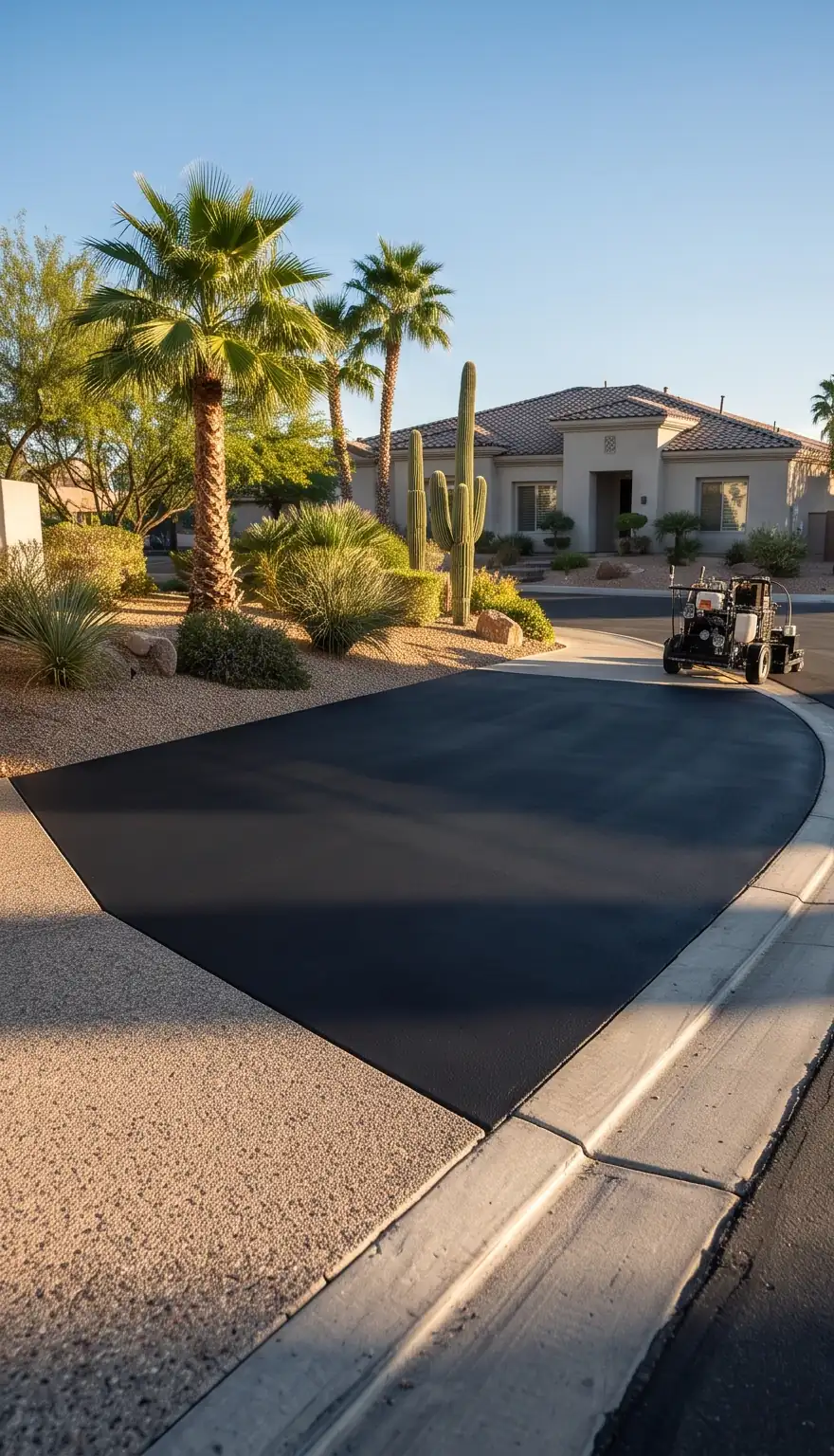
A freshly sealed, deep black driveway does the opposite. It makes the whole property look cared for. We dig into this in how sealcoating improves curb appeal.
Hidden Cost 6: Emergency Timing
When maintenance gets planned, you choose the timing. You pick a season with good weather, schedule around your family, and get the job on the calendar before contractors book up.
When a driveway fails, it fails on its own schedule. A pothole that opens up right before you host family, list the house, or face an HOA inspection forces a rush job. Emergency timing rarely gets you the best scheduling or the most thoughtful scope.
What a Realistic Driveway Budget Looks Like
Here's a simple way to think about your asphalt over its lifetime:
- Every 2 to 3 years: professional sealcoating with UV-resistant, desert-formulated sealant.
- As cracks appear: hot rubberized crack sealing, ideally done right before a sealcoat.
- As needed: targeted pothole and base repairs, done properly the first time.
- At the end of its life: replacement, which with good maintenance comes much later.
The first three items are small, predictable costs. The fourth is the big one, and the whole point of the first three is to push it as far into the future as possible.
Why This Matters More in Las Vegas
Every one of these hidden costs grows faster in the desert. UV and heat age asphalt faster than in milder climates. Big swings between day and night temperatures widen cracks. Monsoon storms deliver a lot of water in a short burst, exactly the conditions that turn small cracks into base failures.
That's why a "wait and see" approach that might work in a mild climate costs more here. For the full picture on how sun and heat break asphalt down, see UV and heat asphalt damage in Las Vegas.
How to Get Ahead of It
You don't need a spreadsheet. You need a quick look at your driveway once or twice a year:
- Is it still black, or fading to gray?
- Are there new cracks, or old ones getting wider?
- Any soft spots, crumbling edges, or loose stones?
- Does water pool anywhere after a storm?
If you answer yes to any of those, the cheapest time to deal with it is now.
Common Budget Questions
Is it better to save up for a new driveway than to keep maintaining the old one?
Only if the old one has truly failed. If the base is still solid, maintenance is far cheaper and buys years of use. Pouring money into a replacement fund while the existing driveway falls apart usually means you end up needing that replacement sooner.
How do I know when maintenance stops being worth it?
When failures are widespread: alligator cracking across most of the surface, multiple potholes, and water pooling everywhere. At that point, repairs chase problems instead of preventing them, and replacement or resurfacing becomes the better value.
Should I do crack sealing and sealcoating at the same time?
In most cases, yes. Sealing cracks right before the sealcoat goes down protects both the cracks and the surface in a single visit, and you only close the driveway once.
Does a newer driveway need maintenance right away?
New asphalt needs time to cure before its first sealcoat, but it shouldn't go years without one. Our guide on when to sealcoat new asphalt in Las Vegas covers the timing.
What's the single best thing I can do this year?
Get the cracks sealed and the surface coated before they reach the next stage. That one move covers most of the hidden costs on this list.
Let Us Build the Plan With You
We'll walk your driveway, tell you which stage it's in, and lay out what it needs now and what can wait. No pressure and no upsell. Just a clear plan that keeps your biggest pavement expense as far down the road as possible.
Seal It Up! Asphalt & Sealcoating is locally owned and serves homeowners in Las Vegas, Henderson, Summerlin, North Las Vegas, Boulder City, Pahrump, Paradise, and Spring Valley. Call 702-915-6591 or request a free estimate today.
Get a straight answer on your pavement
Call 702‑915‑6591 or request a free estimate. We serve Las Vegas, Henderson, Summerlin, North Las Vegas, Boulder City, Pahrump, Paradise, and Spring Valley. Learn more about our sealcoating service.