Every spring, home improvement stores across the valley stack buckets of driveway sealer by the door. The pitch is simple: a squeegee, a weekend, and your gray driveway is black again. For some homeowners, that's tempting. Why pay a contractor for something you can roll on yourself?
It's a fair question, and we'll give you a fair answer. There are situations where DIY is fine. There are more situations where it wastes money and a Saturday. The difference comes down to three things: prep, materials, and the Las Vegas climate.
What a DIY Sealcoat Job Actually Involves
Most people picture the satisfying part: pouring black sealer and spreading it smooth. That's maybe a third of the job. Here's the full list for doing it right:
- Clear everything off the driveway and keep cars off for at least two days
- Sweep and blow off all dirt, sand, and debris
- Scrub oil and fuel stains and treat them so the sealer will stick
- Clean out every crack and fill it with crack filler, then let it cure
- Edge along the garage, sidewalk, and landscaping with tape or a brush
- Stir the sealer thoroughly, since solids settle in the bucket
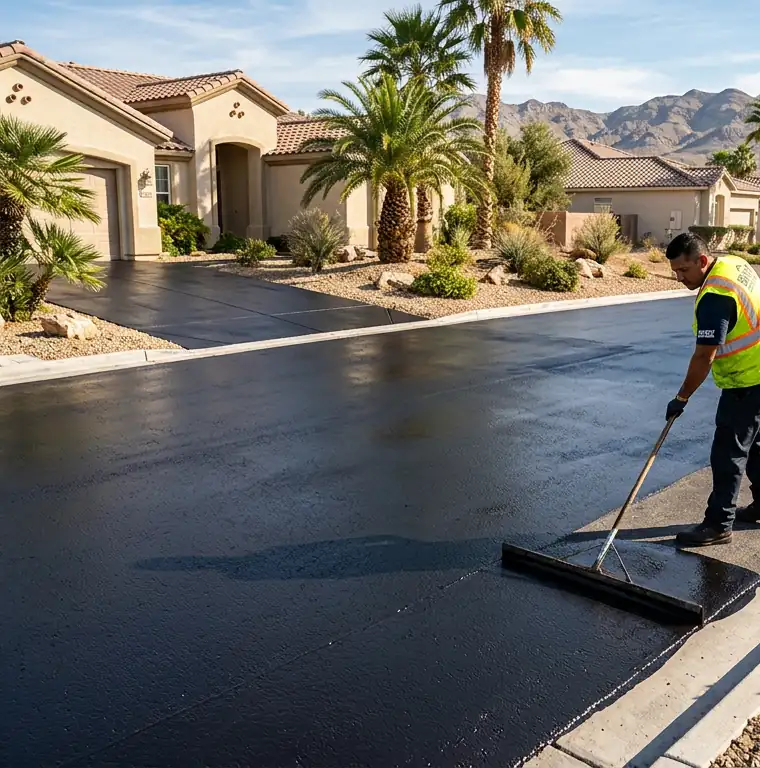
- Apply thin, even coats with a squeegee, usually two coats
- Keep everyone, including pets and delivery drivers, off it while it cures
The prep is where DIY jobs usually fall apart. Sealer applied over dust, oil, or open cracks doesn't bond. It peels, flakes, and wears through in tire paths within months.
The Material Problem
Not all sealer is the same. Many retail products are thinned for easy application and formulated for general use across the country. That means they're built to perform somewhere with snow, rain, and mild summers, not 110-degree afternoons and relentless UV.
We use specialized UV-resistant sealants and materials formulated specifically for desert conditions. That's not a marketing line. It's the reason a professional coat in Las Vegas holds up for the full 2 to 3 year cycle while a thin retail coat often looks tired by the end of its first summer.
Crack filler is the same story. Retail pourable crack fillers tend to shrink and pull away from crack walls as the pavement expands and contracts. Professional crews use hot rubberized crack sealant, which is applied hot, bonds to clean crack walls, and stays flexible through heat cycles. In a climate with big temperature swings, that flexibility is the whole point.
The Heat Problem
Las Vegas heat makes sealcoating easier in one way and harder in another. Warm temperatures help sealer cure. But a driveway surface in direct summer sun gets far hotter than the air. Sealer that hits a scorching surface can flash dry before it levels, leaving streaks, lap marks, and thin spots.
Timing matters. Professionals plan application around surface temperature and the forecast, including monsoon storms that can wash fresh sealer into the gutter. A DIY job squeezed into whatever weekend is free doesn't have that flexibility.
The Real Cost Comparison
On paper, DIY looks cheaper. You pay for buckets, a squeegee, crack filler, and cleaning supplies. But there are costs that don't show up on the receipt:
- Coverage: retail sealer is often thin, so you need more product and more coats than you'd expect.
- Lifespan: a coat that wears through in a year has to be redone sooner, so you buy the materials again.
- Mistakes: sealer tracked onto concrete, stucco, or carpet is hard to remove.
- Missed repairs: sealing over cracks without proper filling leaves the real problem untouched.
- Your time: a full, proper job is a long day or two of hard physical work in the heat.
For a full breakdown of what drives the price of professional work, see our article on how much sealcoating costs.
When DIY Makes Sense
We'll be straight about it. DIY can be reasonable when:
- The driveway is small and in good structural shape
- There are no open cracks, potholes, or soft spots
- You're comfortable with careful prep and can keep the driveway closed for two days
- You understand it's a cosmetic refresh, not a long-term protective coat
When to Call a Professional
Bring in a pro when:
- There are cracks wider than a hairline, or cracks that keep coming back
- There are potholes, crumbling edges, or alligator cracking
- The driveway is large, sloped, or has a lot of edging
- You want a coat that actually lasts the full 2 to 3 years
- It's an HOA, rental, or commercial property where appearance and liability matter
A professional job also comes with an assessment. We look at whether sealcoat alone will do the job or whether cracks and failed spots need repair first. Sealing over a failing base is wasted money whether you do it yourself or pay someone else.
What a Professional Job Looks Like
When we sealcoat a Las Vegas driveway, the sequence is consistent:
- Walk the driveway and explain what we see
- Clean the surface thoroughly and treat oil spots
- Clean out cracks and fill them with hot rubberized sealant
- Patch any failed spots
- Apply desert-formulated, UV-resistant sealant evenly, including edges
- Barricade and give clear guidance on cure time
A residential driveway is usually done in a few hours. Plan on 24 to 48 hours before you drive on it. See the full process in inside the professional sealcoating process.
Questions Homeowners Ask Us About DIY Sealer
Can I put a professional coat over a DIY coat?
Usually, yes, but the old coat has to be in decent shape. If a DIY layer is peeling or flaking, it has to be cleaned up first, because new sealer only bonds as well as the surface underneath it. We check this during the walk-through.
Is two coats of retail sealer the same as one professional coat?
Not really. The difference isn't only thickness. It's the formulation, the prep, and the crack sealing that happens before the coat goes down. Two thin coats over open cracks still leave the cracks open to water.
Will DIY sealer void anything or cause problems later?
It won't hurt the asphalt by itself. The problems come from sealing over dirt, oil, and cracks, and from sealer tracked onto concrete and stucco. Those are cleanup and performance issues, not structural ones.
How do I know if my driveway is too far gone for any sealer?
If you see alligator cracking, potholes, crumbling edges, or soft spots that move under a car, sealer isn't the fix. Those areas need repair first. Our article on signs your driveway needs asphalt repair walks through each stage.
What time of year is best for sealcoating in Las Vegas?
Spring and fall give the most comfortable surface temperatures and the fewest storms, which is why we often point homeowners to the fall window. A pro can work through more of the year because they plan around surface heat and the forecast.
The Bottom Line
DIY sealcoating isn't a scam, but in Las Vegas it often ends up being a short-term cosmetic fix. The prep is harder than it looks, retail materials aren't built for desert heat, and sealing over unrepaired cracks doesn't protect anything. A professional coat with proper crack sealing costs more on day one and less over the life of your driveway.
If you're on the fence, let us take a look. We'll tell you honestly whether your driveway is a candidate for a quick refresh or whether it needs real repair and protection. Call 702-915-6591 or request a free estimate. We serve homeowners across Las Vegas, Henderson, Summerlin, North Las Vegas, Boulder City, Pahrump, Paradise, and Spring Valley, and we'll give you a straight answer either way.
Get a straight answer on your pavement
Call 702‑915‑6591 or request a free estimate. We serve Las Vegas, Henderson, Summerlin, North Las Vegas, Boulder City, Pahrump, Paradise, and Spring Valley. Learn more about our sealcoating service.