Probably not. A crew that knocks on your door with leftover asphalt from a job down the street and offers to pave your driveway today, for cash, is following the exact script the Nevada State Contractors Board describes as a traveling contractor scam. Before you agree to anything, look up the crew's Nevada contractor license. If they cannot give you a license number, or the number does not check out, send them on their way.
Here is how the pitch usually works, why a same day driveway tends to fall apart, and how to check any paver in Nevada before they start.
How the leftover asphalt pitch usually goes
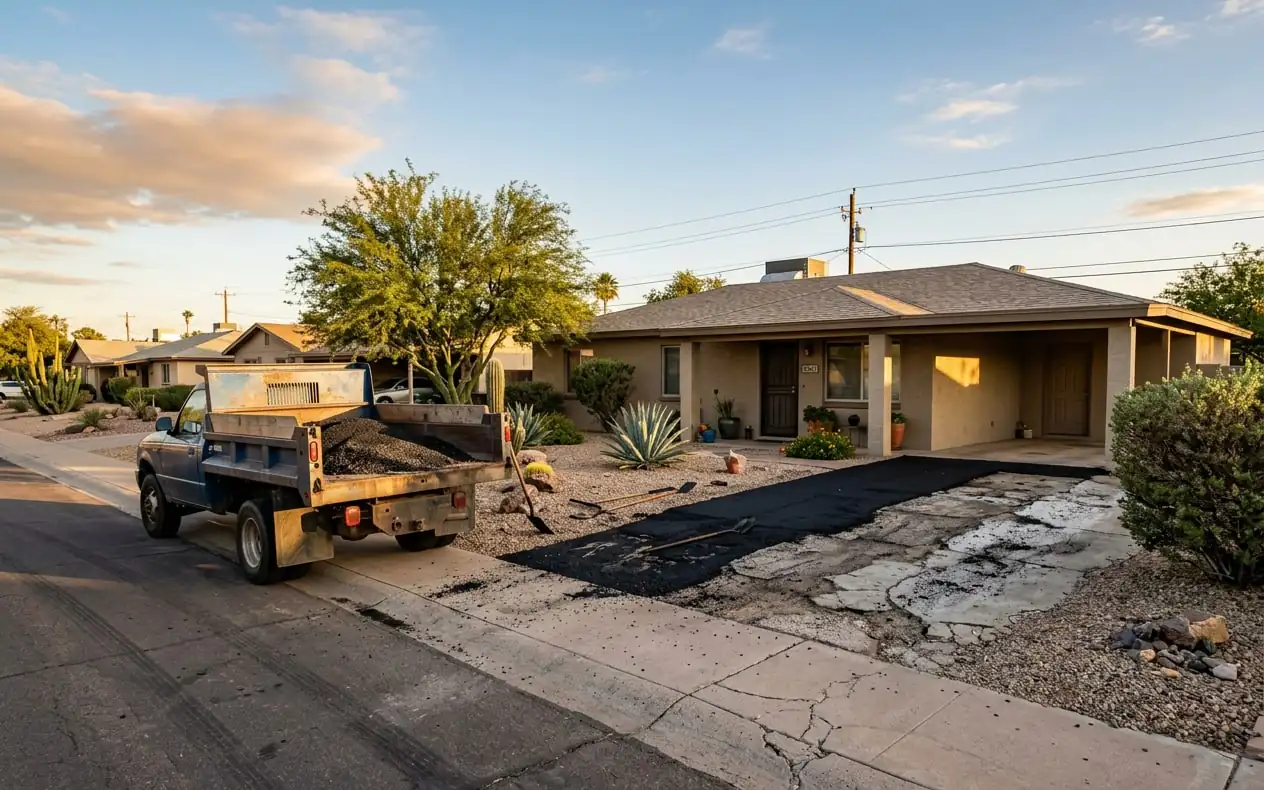
The Nevada State Contractors Board warns that groups of transient crews pose as home repair contractors and go door to door with painting, roofing and paving offers. Its traveling contractor tip sheet lists the claim of leftover material from another job at a cheap price as one of their standard lines. A Board alert on traveling pavers in Clark County describes the same approach: crews claiming to be in the neighborhood with leftover materials, quoting low prices and using high-pressure sales tactics, often aimed at older homeowners.
The Board's red flags for these crews include:
- They knock door to door and want to start right away.
- They are friendly at first but turn to pressure or scare tactics.
- They avoid giving an up-front price or a written contract, then raise the price once the work is under way or done.
- They want cash, or they cash checks immediately, sometimes after changing the amount.
- They drive newer customized trucks with out-of-state plates.
- They give a toll-free 800 number instead of a local number, and a P.O. box or suite number instead of a street address.
- They offer a free inspection and then find problems to fix.
One of the listed scams applies directly to driveways: a crew says it will apply a sealant, then sprays on a useless, watery liquid. A driveway that looks freshly sealed for a week is not the same as a driveway that was actually protected.
Why a cheap same day driveway fails fast
The Contractors Board has said plainly that this kind of work does not last. A Board alert about unlicensed pavers soliciting along Boulder Highway called their cold-rolled paving for potholes and entire parking lots substandard, work that will deteriorate rapidly.
The reason is what gets skipped. A driveway that holds up in Las Vegas heat depends on the parts you cannot see once the job is done: removing failed material, grading so water drains away from the house, a compacted base that will not shift, and hot mix laid and rolled while it is still hot enough to compact. Asphalt that has been riding around in a truck all day, spread thin over an unprepared surface, can look fine for a short time. Then it ravels, cracks and breaks up, and the homeowner is left paying a legitimate contractor to tear it out before the real driveway can go in.
If your driveway already has damage, our post on resurfacing vs. replacement in Las Vegas explains how a contractor decides which one the pavement actually needs.
Checking a Nevada contractor license before anyone starts
In Nevada, all contractors must be licensed before bidding, offering to do work or negotiating a price. That means a paving crew is required to hold a license before it ever quotes you a number at your front door. Checking takes a few minutes:
- Ask for the license number and the business name. A licensed paver will give both without hesitation. Write them down along with the truck plates.
- Look the number up yourself. Use the Board's Nevada contractor license search, or call the Board's Las Vegas office at (702) 486‑1100. Do not rely on a card or a number the crew reads to you.
- Confirm the license is active and the name matches. The business named on the license should be the same business that will sign your contract and take your payment.
- Check that the license covers paving. Nevada licenses carry classifications for specific kinds of work. The search result shows what the license allows.
- Check the monetary limit. Every Nevada license has one: the Board defines it as the maximum contract a licensed contractor may undertake. Your job should fall within it.
Hiring a licensed contractor also matters after the job. The Board's Residential Recovery Fund can pay owner-occupants of single-family homes up to $40,000 for a claim against a licensed contractor, with complaints filed within four years after the work is completed. The Fund is not available to homeowners who hired unlicensed contractors. Paying a traveling crew in cash leaves you with no license to complain against and no fund to fall back on.
What a real paving bid spells out
A legitimate asphalt paving bid gives you something to compare and something to hold the contractor to. The Contractors Board's own list of tips for hiring a contractor, repeated in its paving scam alerts, comes down to a few habits:
- Get at least three bids, and three references with past work you can look at.
- Get a written contract, and do not sign until you understand every term.
- If a deposit is required, pay no more than 10 percent down or $1,000, whichever is less.
- Do not let payments get ahead of the work, and keep a record of every payment.
- Do not pay cash, and do not make the final payment until you are satisfied.
- Keep a job file of every paper related to the project.
On a driveway, a written bid should also say what the job actually includes: the area being paved, whether old asphalt is removed or overlaid, how the base will be prepared, the finished thickness, how drainage is handled, and when the driveway can take a car again. A crew that cannot put those details in writing is not offering a driveway. It is offering a truckload of asphalt.
Who to call if a crew pressures you in Nevada
If a paving crew is pressuring you or a neighbor, or you already paid one, the Nevada State Contractors Board asks you to call its Unlicensed Contractor Hotline: (702) 486‑1160 in Las Vegas. The Board's general line in Southern Nevada is (702) 486‑1100. Contracting without a license in Nevada is a crime: the Board's alerts describe it as a misdemeanor for a first offense, a gross misdemeanor for a second and a Class E felony for a third.
The Board also asks residents to look out for elderly or otherwise vulnerable neighbors, since they are the most common targets. If you see a crew working a street, a quick word with the neighbor and a call to the hotline can stop a bad driveway before it is poured.
Get a straight answer on your pavement
Call 702‑915‑6591 or request a free estimate. We serve Las Vegas, Henderson, Summerlin, North Las Vegas, Boulder City, Pahrump, Paradise, and Spring Valley. Learn more about our asphalt paving service.