Your Driveway Survived the Summer Now You Have About Six Weeks to Protect It
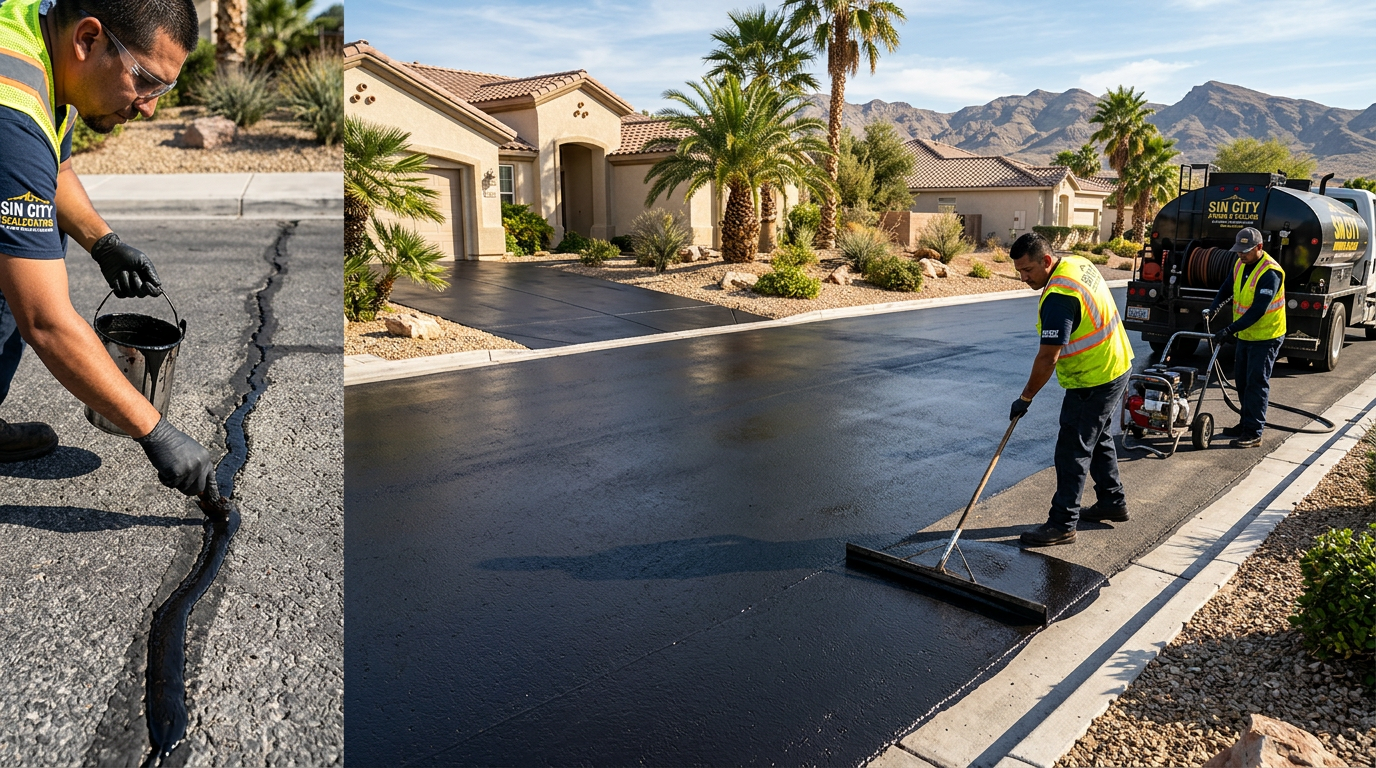
Your driveway just survived another Las Vegas summer. That sounds like an achievement, but look at it closely. The surface that was deep black a few years ago is now gray, brittle, and laced with hairline cracks along the edges and expansion joints. Most homeowners see this and assume nothing can be done until spring. That is exactly wrong, and waiting another six months is the decision that turns a sealcoating job into a repaving bill.
September is the sweet spot for driveway sealcoating Las Vegas NV homeowners rarely hear about. Everyone tells you to avoid summer. Almost no one explains why the weeks right after summer ends are actually the best conditions of the year to protect your asphalt.
What a Full Las Vegas Summer Does to Unprotected Asphalt
From June through August, Las Vegas pavement absorbs direct sun at temperatures that routinely exceed 110°F at the surface. That UV exposure does not just fade the color. It breaks down the binders in the asphalt mix, the compounds that hold aggregate together and give the surface its flexibility. Once those binders oxidize, the surface becomes brittle. Cracks form. Water gets in during the monsoon season. The base erodes from underneath, and what started as a surface problem becomes a structural one.
We regularly see driveways that held up fine for years hit an inflection point after one neglected summer. The driveway did not suddenly collapse. The cumulative UV damage finally crossed the threshold where surface treatment alone cannot reverse what has happened, and resurfacing or full replacement becomes the conversation instead of a routine sealcoating appointment.
If your driveway is already showing signs beyond simple graying, take a look at the signs your driveway needs asphalt repair before scheduling a sealcoat, because some conditions require crack or pothole repair first.
Why September Curing Conditions Are as Close to Ideal as Las Vegas Gets
Here is the part most homeowners do not know. Sealcoat needs three things to cure properly: a dry surface, ambient temperatures consistently above 50°F (ideally 75°F or higher during and after application), and enough time before rain or dew can settle on the fresh coat.
In mid-summer, the heat itself is the problem. Surface temperatures above 130°F cause sealant to flash-dry before it bonds correctly. The product cures too fast and too thin. It looks sealed. It is not.
In October and November, temperatures drop fast enough that nighttime lows begin to threaten proper curing. December through February is not a sealcoating window in most years.
September, specifically mid-September through the end of the month, delivers afternoon highs in the low-to-mid 90s, stable overnight temps well above 60°F, and pavement that is bone dry from months without meaningful rainfall. The surface is also at its most porous after summer oxidation, which means the sealant penetrates and adheres better than it would on a newer or less-weathered surface. Maximum penetration, near-perfect curing temperatures, no rain risk. This window closes. By late October, you are gambling on nighttime conditions.
Miss September and You Are Waiting Until Next Fall
This is not a soft deadline. Sealcoat applied below 50°F ambient temperature does not cure. It peels. Las Vegas winters are mild by most standards, but nighttime lows in December and January regularly drop into the 30s, and even a cool November night can compromise a fresh coat.
The practical result: a homeowner who decides to wait until it cools off more ends up waiting until March or April at the earliest. By that point, your driveway has absorbed another full winter of thermal contraction. Cracks that were hairline in September are now wide enough to require hot rubberized crack sealing before a sealcoat will do anything useful.
Skipping this cycle is not neutral. A sealcoat every two to three years is inexpensive insurance. A partial or full repave is not. The difference between those two outcomes is often one missed maintenance window.
Cracks Come First, and September Is the Right Time for Those Too
If your driveway has visible cracking, sealcoating alone does not address it. Sealcoat is a surface treatment. It fills hairline surface checking, but it does not bridge structural cracks. A crack left open lets water down to the aggregate base. When that base erodes or shifts, the pavement above it fails from the bottom up.
Hot rubberized crack sealant is the correct repair for open cracks before a sealcoat goes down. The material is flexible, so it moves with the thermal expansion and contraction that Las Vegas pavement experiences every single day, and it creates a watertight seal that prevents further base damage.
September is an excellent time for this work for a reason most people miss: the pavement has fully expanded in summer heat, so cracks are at their widest. The sealant fills and bonds completely, without leaving voids that reopen when the pavement contracts in cooler months.
Repair the cracks, let the sealant cure, then apply the sealcoat. That sequence, done in September, gives your driveway the best possible protection going into fall and winter.
What Homeowners Ask Before Scheduling a Sealcoat
My driveway looks pretty bad. Is it too far gone for sealcoating?
We hear this constantly, and the honest answer is: it depends on the type of damage, not just how it looks. Gray, oxidized asphalt that is still structurally sound responds very well to sealcoating. The surface looks dramatically better and the sealant restores protection that UV damage stripped away. If there are cracks, we address those first. If there is base failure, alligator cracking, or areas that flex underfoot, sealcoating is not the right tool and we will tell you that directly rather than take your money for a job that will not hold.
How long does sealcoat actually last in Las Vegas heat?
In Las Vegas, plan on two to three years between applications for a residential driveway. The UV exposure here is significantly more aggressive than what most national sealcoating guides are written around. Products applied here need to be formulated for desert conditions, not the mid-Atlantic climate most sealcoating research references. We use UV-resistant sealants selected specifically for this region, which extends the service life compared to generic formulations.
Can I sealcoat it myself to save money?
You can, but the results are not the same. Squeegee-applied consumer sealers from a home improvement store are thinner products with lower solids content, and they are not UV-rated for Las Vegas conditions. The bigger issue is surface prep. Proper cleaning, crack repair sequencing, and application technique all affect how well and how long the sealcoat holds. The real-world tradeoffs between professional sealcoating and DIY go beyond the product cost, and most homeowners who try it once hire it out the next time.
I've been told I need to repave. Should I get a second opinion before I spend that money?
Yes. Get two. Full repaving is sometimes the right call, but it is also the most expensive option, and not every contractor is equally motivated to recommend the cheaper one. If someone looked at your driveway for five minutes and handed you a repaving quote without discussing crack repair or resurfacing first, that is worth questioning. A driveway with oxidation damage, moderate cracking, and a sound base is often a sealcoating and repair candidate, not a replacement. We will tell you which one applies to your situation, including when it is the answer we do not profit from.
Do I need to be home during the job?
No. Residential driveways are typically completed in a few hours. Cure time is 24 to 48 hours before vehicle traffic. Keep cars off it overnight, and we will walk you through the timing before we start.
Book Your September Appointment Before the Window Closes
September books fast for exactly the reason this post describes. Las Vegas homeowners and property managers who know the seasonal window act on it early. If you wait until you are ready to schedule and find two-week lead times, the calendar has already moved against you.
Seal It Up! is locally owned and based in the Las Vegas Valley. We serve homeowners, HOAs, and commercial property managers across Las Vegas, Henderson, Summerlin, North Las Vegas, Boulder City, Pahrump, Paradise, and Spring Valley. Every job uses UV-resistant sealants and materials formulated for desert conditions, not products designed for climates that get real rain and do not see 110°F summers.
Call 702-915-6591 to schedule your free estimate. Tell us what your driveway looks like right now and we will give you a straight assessment of what it needs and what it will cost. You will leave the call knowing exactly what shape your pavement is in and what the repair versus replace tradeoff looks like for your specific driveway. No obligation, no upsell.
Your driveway earned a break after this summer. September is the time to give it one.