Your HOA's Parking Lot Budget Window Is Already Closing
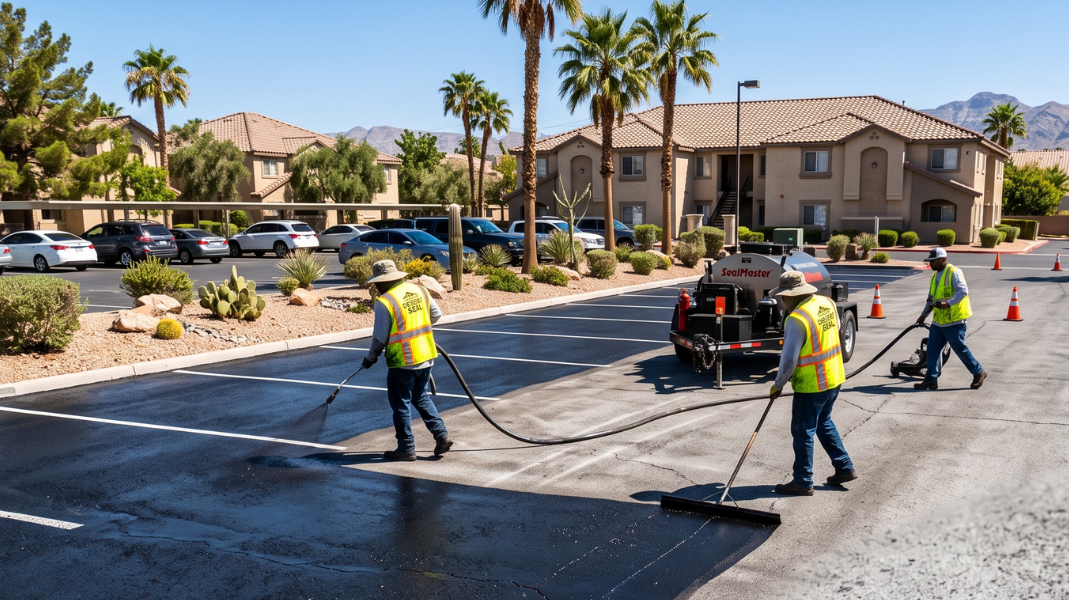
Most HOA boards treat parking lot repairs as a maintenance problem. They are actually a budget timing problem. The physical condition of your pavement determines how urgent the work is, but the budget approval cycle determines whether it actually gets funded this year or gets pushed another twelve months while the damage compounds. If you manage a community in Las Vegas, Henderson, Summerlin, or anywhere else in the valley, you already know that HOA parking lot paving decisions do not happen in a vacuum. They run on fiscal calendars, board votes, and vendor timelines that most contractors never bother to understand. That disconnect is expensive.
HOAs that miss the October planning window consistently defer work a full year. In a desert climate where summer temperatures exceed 115°F and UV exposure degrades unprotected asphalt faster than almost anywhere else in the country, one deferred year means visible deterioration, wider cracks, and a repair estimate that climbs sharply by the time the next budget cycle opens.
Why October Is the Real Deadline, Not January
HOA fiscal years vary, but the majority of boards in the Las Vegas Valley run on a calendar year. Budget proposals go to the board in October and November, get approved in December, and become available January 1. If you want paving or sealcoating work funded in the coming year, you need a vendor quote, a scope of work, and a board presentation ready before November. That is not a lot of runway.
Here is where the timing problem compounds. Contractor schedules fill up from February through May as the weather cools and property managers rush to get work done before summer heat peaks. An HOA that secures budget in January but waits until March to call a contractor regularly lands at the back of the line, pushing work into April or May at best, sometimes later. Get the quote in October. Get it approved in November or December. Schedule the work in January.
Waiting Costs More Than the Repair Does
This is the argument that actually moves boards, and it is not a scare tactic. It is straightforward math tied to how asphalt fails.
Sealcoating a parking lot costs a fraction of resurfacing or repaving it. Parking lot sealcoating in Las Vegas extends pavement life by protecting the binder that holds asphalt together against UV oxidation and heat. Once that binder breaks down, the surface grays, becomes brittle, and cracks form. Cracks let water in. In Las Vegas, that means monsoon-season moisture seeps under the surface and undermines the base. The base softens. Now you have structural failure, not a surface problem. Structural failure means full repaving, and full repaving costs several times more than a maintenance cycle that could have prevented it.
We regularly see parking lots that were sealed on schedule holding up well after ten or twelve years, still candidates for resurfacing rather than full replacement. Properties that skipped two or three maintenance cycles are often looking at full reconstruction of sections where base damage has spread. The cost difference between those two outcomes is not marginal. If you need the financial case laid out for a board presentation, the hidden costs of deferred asphalt maintenance are worth walking your board through before the budget discussion opens.
What to Put in Front of Your Board Right Now
Board members are not asphalt professionals. They are volunteers trying to make responsible decisions with limited information and real fiduciary responsibility to the community. The most effective board presentations do three things: show the current condition clearly, translate that condition into a cost trajectory, and present a specific, actionable proposal.
Start by documenting your parking lot now. Walk the property and photograph every visible crack, any areas of surface raveling, faded or missing striping, and any depressions or soft spots that suggest base movement. Photographs from two or three years ago compared to current condition tell a clearer story than any written description.
Then get a professional assessment. A written estimate from a contractor who has actually walked the lot gives the board a real number to evaluate, not a range from a website. It also gives you a defensible basis for the spend. A board that votes to approve a specific scope of work at a quoted price is in a far better position than one that approves a vague line item and figures out the details in February.
Frame the choice correctly. The question is not whether to spend money on the parking lot. The question is whether to spend a maintenance amount now or a replacement amount later. Present both numbers. Let the board make an informed decision.
How the Mojave Changes the Maintenance Math
Las Vegas is not Phoenix, and it is not Denver. The combination of extreme UV exposure, temperatures that regularly exceed 110°F in summer, and monsoon-season water intrusion creates a failure pattern unique to the Mojave. A sealcoating cycle that holds for three years in a northern city often needs to run closer to two years here. That compression reflects what sustained extreme heat does to sealant that was not formulated for this environment.
Generic maintenance schedules from national property management templates are not calibrated for this climate. Standard sealants designed for moderate climates break down faster under sustained desert heat. That shortens the protection window and means the lot degrades faster between cycles, whether or not anyone notices until the cracks arrive. HOA boards in the valley need to work with contractors who use UV-resistant sealants formulated for desert conditions, not the same products applied in Seattle or Chicago.
What HOA Boards Ask Before They Sign Off
Our reserve study already allocated funds for pavement. Do we need a separate board vote to release them?
This is a common source of delay, and it is worth clarifying with your HOA attorney or management company now rather than in February when you are trying to schedule work. Many HOAs require a board vote to release reserve funds even when the reserve study anticipates the expense. Getting that vote scheduled early removes a bottleneck that pushes work out of the prime scheduling window every year.
We have not sealed this lot in five years. Is sealcoating still the right answer, or do we need something more?
The answer depends on the condition of the surface. If cracking is widespread and the surface shows significant oxidation but the base is still structurally sound, crack sealing followed by sealcoating is often still the right move. If you have sections with base failure, those need a different approach entirely. Get a contractor to walk the property and give you an honest assessment of what each section actually needs before you commit to a scope.
What happens if we approve the budget but the board changes after the annual election?
Incoming board members sometimes want to revisit approved spending, which can stall work that was already scheduled. The cleaner solution is to get the work contracted and scheduled before any transition, not just approved in principle. A signed contract with a start date is much harder to defer than a budget line item.
How long will the lot be out of service during work?
For sealcoating, plan on 24 to 48 hours before vehicle traffic returns. For larger crack repair and sealcoating projects, scheduling sections in phases lets residents maintain access to part of the lot while work progresses. We work with HOA property managers to plan phased schedules that minimize disruption to residents.
Can we get work done in winter?
Yes. Crack sealing and pothole repair hold up well in Las Vegas winters, and cooler temperatures actually make extended sealcoating projects easier to manage without heat-related application issues.
Get Your Scope and Quote Before the Budget Window Closes
If your parking lot needs work and your budget cycle opens in January, October is the time to act. Not because of any artificial deadline, but because getting a quote, presenting to the board, securing approval, and scheduling a contractor before the spring rush takes every one of those weeks.
Seal It Up! Asphalt and Sealcoating is locally owned and operated, and we work directly with HOA boards and property managers across Las Vegas, Henderson, Summerlin, North Las Vegas, Boulder City, Paradise, and Spring Valley. We use UV-resistant sealants and materials formulated for desert conditions, and we give you a straight assessment of what your lot actually needs, not the most expensive scope we can build.
Call us at 702-915-6591 or request a free estimate for your community's parking lot. Walk the property with us before your next board meeting. You will leave with a real number, a defined scope, and something concrete to put in front of your board while the budget is still open.